
Une question sur ce lot ?
vente
jeu. 29 janvier à 14h00
expo
Lot n°1
Vente en préparation...
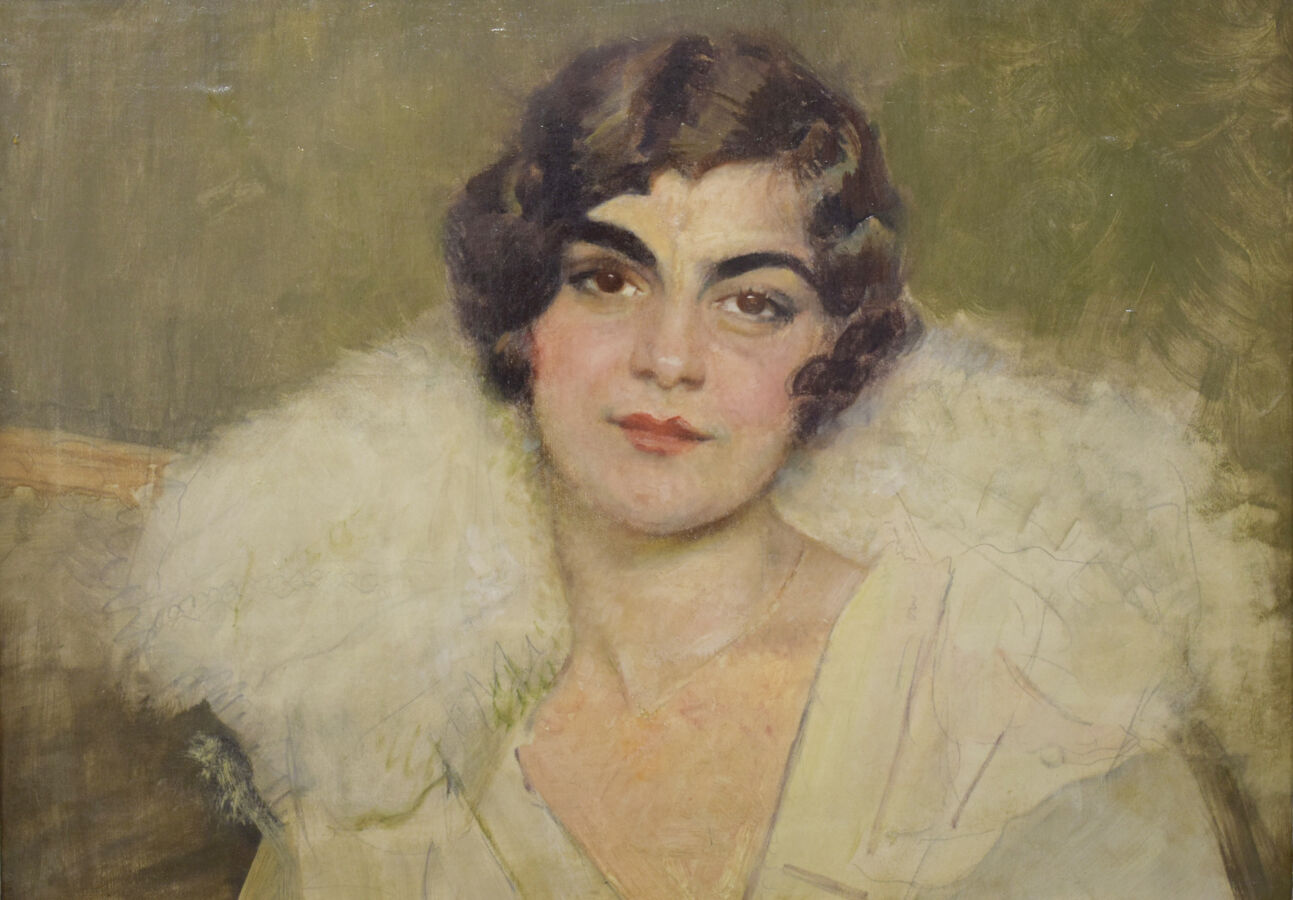
Amrita SHER-GIL (1913-1941), "Portrait d'Edith", 1932, huile sur toile, marouflée sur isorel, signée au dos du carton rigide, 44 x 60.5 cm.
*Collection privée française
Le modèle représenté est très vraisemblablement Edith Láng László, née en 1907, pianiste formée au Conservatoire international de musique de Paris, où elle obtient en 1932 un Grand Prix de virtuosité. Sa carrière précoce l'inscrit dans les cercles artistiques européens croisant alors la route d'Amrita Sher-Gil. Elle est notamment citée par Fleurette Beauchamp-Huppé, soprano et professeure canadienne, qui évoque un travail commun au piano en 1933-1934.
Au-delà de sa présence dans le milieu musical, Edith occupe un rôle important dans la vie personnelle d'Amrita Sher-Gil. Lors d'un séjour en Hongrie au début des années 1930, Amrita s'engage brièvement dans une relation avec Edith, qui devient son amante. Cette liaison marque un moment charnière dans l'affirmation de la vie intime et créative de Sher-Gil. Leur relation a d'ailleurs contribué à cristalliser certaines rivalités affectives au sein de son cercle, notamment avec Marie-Louise Chassany, amie proche et colocataire de Sher-Gil durant ses études aux Beaux-Arts.
Au verso du support, un extrait de Thaïs de 1894, opéra de Jules Massenet, agit comme un arrière-plan symbolique. L'opéra raconte le destin de Thaïs, courtisane scandaleuse et fascinante, que le moine Athanaël veut sauver par la foi, avant d'être lui-même consumé par le désir qu'il croyait dominer.
Sher-Gil, qui n'a jamais séparé vie intime et élan créatif dans ses portraits, inscrit ici Edith dans une narration silencieuse : celle de la musicienne virtuose, indépendante, évoluant au coeur d'un Paris artistique intense, ouvert aux audaces affectives autant qu'aux réinventions personnelles. Le choix de cette partition fait glisser le portrait hors du simple hommage biographique et le place dans un territoire plus subtil : celui de la muse.
La datation du portrait s'inscrit clairement dans la période parisienne de l'artiste, entre 1930 et 1932, avant son retour en Inde. Le modèle, représenté en buste, est assis de face sur une banquette, le corps légèrement tourné vers la gauche. Son regard se pose sur le spectateur, contribuant au caractère introspectif et délicatement intime de la scène. Le dessin demeure perceptible et la touche, volontairement vaporeuse, confère à l'ensemble une atmosphère de douceur et de retenue.
* * *
The model depicted is most likely Edith Láng László, born in 1907, a pianist trained at the International Conservatory of Music in Paris, where she won a Grand Prix for virtuosity in 1932. Her early career brought her into European artistic circles, where she crossed paths with Amrita Sher-Gil. She is mentioned in particular by Fleurette Beauchamp-Huppé, a Canadian soprano and teacher, who refers to their working together on the piano in 1933-1934.
Beyond her presence in the music world, Edith played an important role in Amrita Sher-Gil's personal life. During a stay in Hungary in the early 1930s, Amrita briefly entered into a relationship with Edith, who became her lover. This liaison marked a turning point in Sher-Gil's personal and creative life. Their relationship also helped to crystallise certain emotional rivalries within her circle, notably with Marie-Louise Chassany, a close friend and flatmate of Sher-Gil's during her studies at the Beaux-Arts.
On the reverse side of the support, an excerpt from Jules Massenet's 1894 opera Thaïs serves as a symbolic backdrop. The opera tells the story of Thaïs, a scandalous and fascinating courtesan whom the monk Athanaël wants to save through faith, before being consumed himself by the desire he thought he had mastered.
Sher-Gil, who never separated her private life from her creative impulse in her portraits, places Edith here in a silent narrative: that of the virtuoso musician, independent, evolving in the heart of an intense artistic Paris, open to emotional daring as well as personal reinvention. The choice of this score shifts the portrait away from a simple biographical tribute and places it in a more subtle territory: that of the muse.
The portrait clearly dates from the artist's Parisian period, between 1930 and 1932, before his return to India. The model, depicted in bust form, is seated facing forward on a bench, her body slightly turned to the left. Her gaze rests on the viewer, contributing to the introspective and delicately intimate nature of the scene. The drawing remains visible and the deliberately hazy brushwork gives the whole a gentle and restrained atmosphere.